CASE STUDY | OIL & GAS
Failure Analysis of O-Rings
A global engineering and technology services company submitted O-rings for failure analysis following in-service failure after approximately eight years of operation. The seals were used in a process gas application operating at 139.3 bar(g), with a temperature range of 2°C to 32°C.
The customer indicated that the O-rings were believed to be manufactured from one of four possible elastomer grades; two HNBR compounds and two FPM compounds. The objective was to determine the likely material composition of the seals and identify the root cause of failure.
Assessment
Visual and Physical Examination
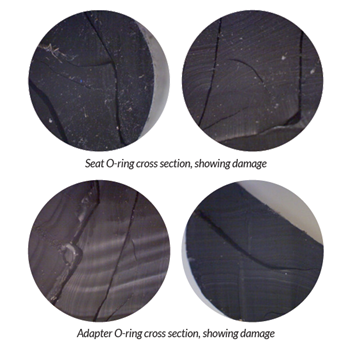
Initial visual inspection indicated damage consistent with rapid gas decompression (RGD). The failure characteristics included localised internal damage and swelling confined to the affected areas. There was:- No evidence of extrusion damage
- No signs of thermal degradation
- No indication of chemical attack
The swelling observed was limited to the damaged regions and was not uniform across the seal body, further supporting a mechanical failure mechanism rather than chemical incompatibility.
Material Evaluation
A review of the customer-provided datasheets allowed elimination of the two proposed HNBR grades, as these were specified as RGD-resistant materials and would not be expected to fail in this manner under the stated operating conditions. Density testing of the returned seals produced the following results:- Seat O-ring: 1.291 g/cm³
- Adaptor O-ring: 1.293 g/cm³
These values fall below the typical density range of standard FPM compounds and therefore discounted the two suggested FPM material options. Based on density comparison and observed performance characteristics, the material was assessed as most likely being a standard grade nitrile (NBR) compound.
Dimensional Verification
Due to the size and condition of the returned seals, accurate inner diameter measurements could not be obtained. Cross-sectional measurements were therefore used to validate seal sizing.Conclusion
Although conflicting information from the customer prevented absolute confirmation of the original material specification, the investigation indicated that:
- The seals installed in the valve were not RGD-resistant.
- The failure mode was consistent with rapid gas decompression.
- Density measurements strongly suggested the material was not FPM and was more likely a standard nitrile compound (or potentially a non-RGD-resistant HNBR variant).
Recommendation & Outcome
To prevent recurrence and improve service life in high-pressure gas applications, it was recommended that the seals be replaced with an RB13 profile manufactured from an RGD-resistant HNBR compound. This material selection would provide improved resistance to decompression damage and significantly increase seal reliability under the stated operating conditions. We subsequently manufactured the recommended seals, which demonstrated successful performance in operation.

 Download Case Study