CASE STUDY | OIL & GAS
Seals for API 10,000 Choke Valve
We were approached by an industry leading control and choke valve manufacturer to provide a solution to a sealing issue they had. Our customer had attempted to make their product more competitively priced while also reducing the time it took to deliver it to the marketplace. They had identified they could do this by removing the lengthy sub-contract surface grinding and polishing processes that were used in the manufacture of the valves. However, by removing these processes, our client found that this caused a major problem, as their existing sealing arrangements would no longer function.
Assessment
The valves were class API 10,000 / -29 to + 121ºC and required to be PR2 tested using Nitrogen gas in accordance with API 6A - Annex F, 20th edition. The surfaces of the metalwork had gone from being a ground and polished 0.1~0.2 Ra finish to <0.4Ra machined finish. This meant our customer’s current PTFE lip seal arrangement could not tolerate the new surface finishes and the seals failed when subjected to gas test criteria.
Solution
We designed a bespoke packing set for the stem seal arrangement. This consisted of a high deflection PTFE lip seal, incorporating a number of PTFE and RGD resist-ant elastomeric ‘V’ segments behind it, to provide total sealing redundancy, and a virgin PEEK anti-extrusion ring to prevent extrusion failure under high pressure and temperature.
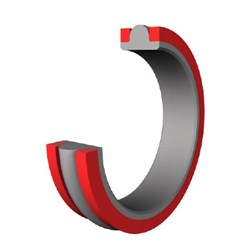
The seat seal was replaced with an RGD resistant elastomeric ‘P’ Seal, complete with a Virgin PEEK anti-extrusion ring. All of the materials used to produce the sealing components had been independently immersion tested and qualified to API6A / ISO 10423 F.1.13 class FF/HH.
Result
The sealing arrangements were installed into the valve and the stem mounted in a vertical position. They were then PR2 tested according to test procedure API 6A - Annex F (20th Edition) using Nitrogen as the fluid. The valve successfully passed all the requirements of the API 6A test procedure and a witness certificate was awarded.