V-Rings
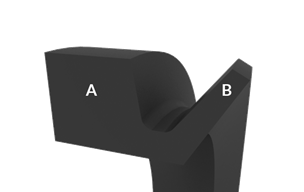
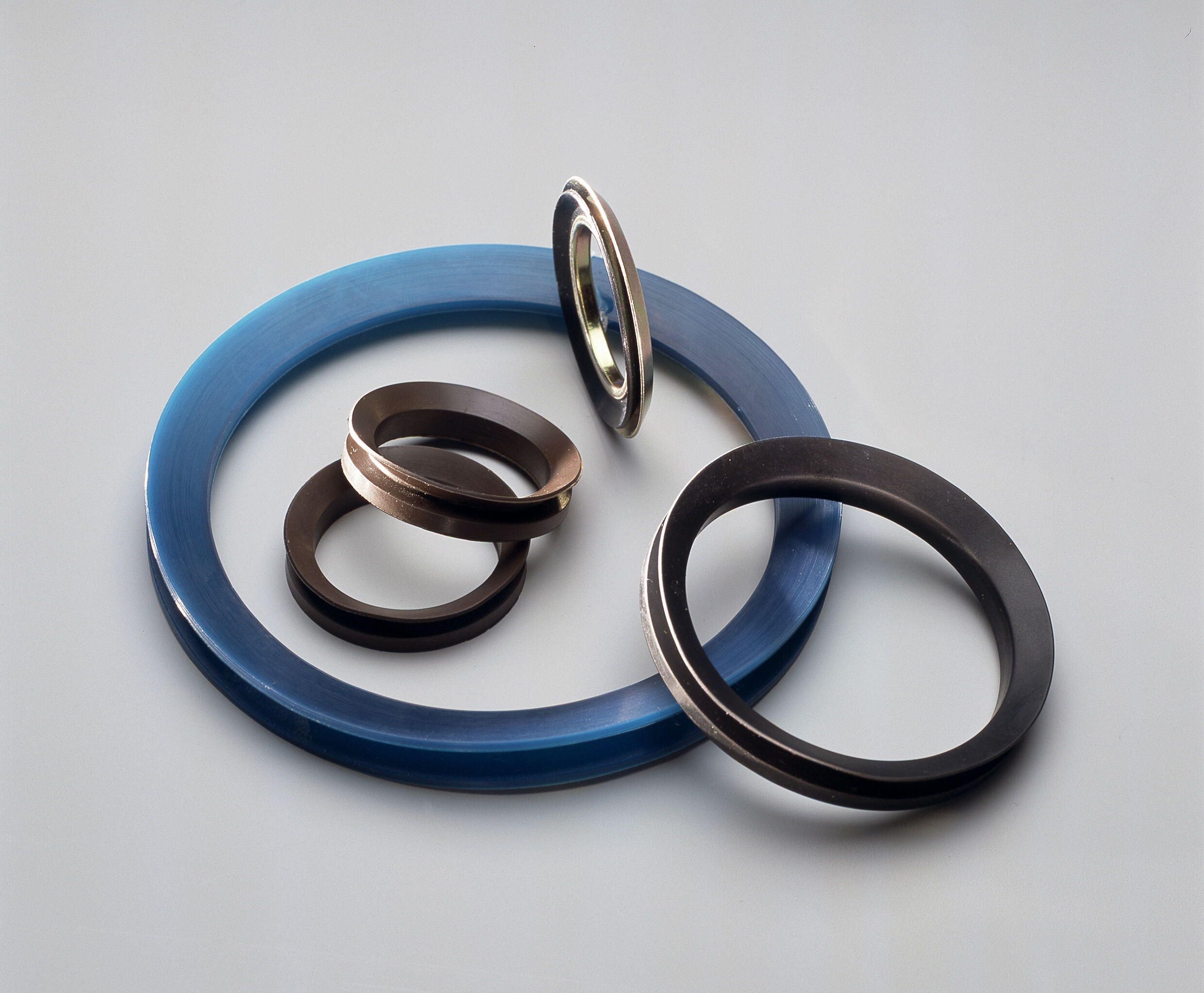
A V-ring is a one-piece moulded sealing ring made from synthetic rubber. Composed of two parts, the V-ring body (a) and the flexible, self-tightening sealing lip (b), V-rings can seal even with larger misalignments and eccentricities. This makes V-rings a reliable and cost-effective sealing solution for a wide range of applications.
V-rings are mounted on, and rotate with, the shaft. The lip seals axially against a counter face, which is perpendicular to the shaft. The body has an interference fit on the shaft and holds the lip in position. This type of seal can be stretched out and fitted over a flange during installation, which is a valuable characteristic, especially in the case of repair. V-rings can operate at sliding velocities up to 8 m/s. At velocities above 8 up to 12 m/s, v-ring seals need to be axially located.
The advantages of V-rings
- Simple construction: Typically, no separate housing is needed. Grinding of the shaft is not necessary, and coarse tolerances can be accepted.
- DUO-function: The V-ring has a duo-function as it acts as a seal as well as a deflector ring.
- Low friction: Due to friction, the power loss is much less for a V-ring than a spring-loaded shaft seal. At about 10m/sec, the friction drops rapidly due to the centrifugal force on the lip.
MaterialsV-rings are normally made of nitrile rubber. For applications where higher temperatures occur or where aggressive media are present, V-rings made of fluorocarbon rubber should be used.
NBR -40 to +100°C
The standard material with good resistance to oil, grease, weak acids, alkalis, and many other fluids.
FPM (Viton ™) -30 to + 200°C
It is preferred for high-temperature applications and with more aggressive fluids.
CR, EPDM and HNBR materials are also available for specific applications, e.g. enhanced weather resistance. The materials are supplied per request.V-ring profile types
V-rings are available in four standard types (shown below). Each of these profiles has a unique design and is suitable for specific sealing applications.

Type VA is the most common profile and is available for shaft diameters starting from 2.7 mm up to almost unlimited sizes. It has a versatile design and is suitable for a wide range of applications. It provides good sealing properties and can handle misalignments and eccentricities. 
Type VS provides a stronger radial hold on the shaft but requires more space due to its wider cross-section. It is available for shaft diameters ranging from 4.5 mm to 210 mm. It is suitable for applications where a stronger hold on the shaft is required. 
Type VL is designed for applications where space is limited. It has a thinner cross-section than the other profiles, allowing it to fit in tight spaces. It is available for shaft diameters ranging from 135 mm to 630 mm.
Type VE is designed for heavy-duty applications where a large diameter seal is required to exclude dirt and water. It is suitable for applications such as paper mills, rolling mills, and other applications with large axial movements. It is available for shaft diameters ranging from 450 mm to 2000 mm and can be supplied with an additional radial retaining band for better fixation. - Simple construction: Typically, no separate housing is needed. Grinding of the shaft is not necessary, and coarse tolerances can be accepted.