CASE STUDY | OIL & GAS
Spring Energised Seals for Cryogenic QCDC Coupler
We were approached by a world leading coupling manufacturer to help provide a solution to a sealing issue they had with a new product. Our clients objective was to design a new type of QCDC coupler in an attempt to bring a quicker and safer cryogenic fluid transfer product to the market. They were having continuous issues with the main seal used in the connection between the coupler and the supply vessel.
Our customer had already used a number of different manufacturers and various sample seals with little or no success. With our customer ready to scrap the project and write-off hundreds of thousands of pounds, they contacted us to see if we could find a solution.
Assessment
Our technical team visited our clients facility and established the full application requirements. The QCDC coupler was required to transfer cryogenic liquified gases such as LNG at temperatures as low as -196ºC. The failure modes of various seals the customer had already trialled were then investigated and a report compiled. Some of the failures were simply caused by damage on installation, so we advised the lead-in chamfer required alteration. Many of the samples were simply of a poor standard, surprisingly one batch contained a spring energiser that was not welded and had visible gaps where the spring ends should meet. None of the seals our client had tested up until this point worked for more than 10 hours before failure.
Solution
We designed a bespoke spring energised seal which would utilise our customers existing metalwork, this meant no redesign work was required by our client. The combination of a special high-load spring energiser and fluoropolymer seal jacket was proposed to enable the seal to provide leak-tight performance and resist shrinkage while performing at cryogenic temperatures.
Result
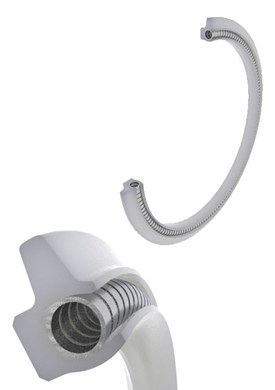
Seals were supplied to our customer 3 days after our initial assessment and easily installed into the QCDC after the initial lead-in chamfer modification had been made. The seal was placed under rigorous quick connect / disconnect procedures at -196ºC for 168 hours and zero leakage was recorded. Our client was so pleased with the results of the test and the speed in which we had reacted to their problem that we were invited to look at a secondary seal design. This new seal was similar to the initial brief, but with an angled sealing face as per the image on the right of this page. Tests were repeated and zero leakage was once again reported.